

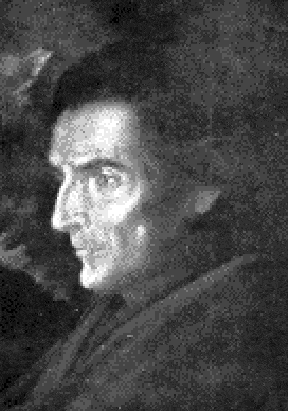
José de Acosta
José de Acosta (October 1, 1540 to February 15, 1600). José de Acosta was a scientist and missionary in Spanish America who received the nickname “the Pliny of the New World.” He was ordained a Jesuit as a young man and, when he was 31 years old, he was assigned to the Andes. There he founded several schools, including those in Panama, Arequipa, Potosí, Chuquisaca and La Paz. He later held the chair of theology at the University of San Marcos in Lima and was also elected provincial of the Society in Peru in 1576.
Acosta is mentioned both supervising the casting of a large bell and investigating the tides of the straits in view of the possible attack by the Englishman Francis Drake. He also directed the preparation of the Trilingual Catechism and Breviary (Spanish, Aymara and Quechua). In addition, he made at least three long trips through the interior of Peru in which he visited the missions established there, which allowed him to learn about the nature and social life of the indigenous people.
Two of his scientific contributions can be highlighted. The first is to discover the Humboldt ocean current, in the eastern Pacific Ocean next to South America (250 years before the Prussian scientist Alexander von Humboldt).
The second is related to evolution. In 1590 he published Natural and Moral History of the Indies, which discusses the elements, metals, plants and animals found there, as well as the rites, ceremonies, laws and government and wars of the Indians. There he postulates a somewhat evolutionary interpretation of animal, plant and cultural reality. He suggested that all of the animals of America would be nothing more than a modification of the originals of Europe, where the difference in various characteristics of the animals could be caused by various accidents. For this reason he is cited in several books on the history of science as the founder of the field of biogeography, which consists of the study of the geographical distribution of living beings on Earth throughout evolutionary history. His bold contributions made him anticipate some of the work of Alexander von Humboldt (who quotes him profusely) and Charles Darwin (who copies what Humboldt says) in some ideas about the distribution and migrations of living beings in Hispanic America for millions of years.
[Author: Leandro Sequeiros San Román, professor of paleontology. Faculty of Theology of Granada. President of ASINJA (Asociación Interdisciplinar José de Acosta).]
Explore Other Scientists
It is our hope that this curated set of biographies will be useful to teachers, students, and the general public.