

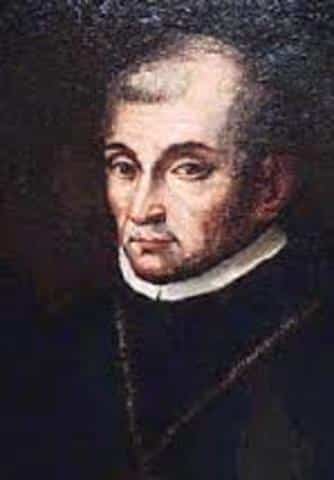
Domingo de Soto
Domingo de Soto (1494 – November 15, 1560). The Dominican priest Domingo de Soto was one of the main scholars of the “Spanish golden age.” After his training at the University of Paris, he was first a professor at the University of Alcalá and then at the University of Salamanca (in between he joined the Dominican order). Soto made contributions to many fields. His breadth of knowledge is reflected in the saying of university students of his time, “Whoever knows Soto, knows everything.” In theology, he explored the relation between grace and nature, and his reputation was such that he was called upon to participate in the Council Trent. He also worked in philosophy, economics, and law. In law, he left his mark with the first treaty on the rights of the poor and the formation of the Ius Gentium in defense of indigenous people, and is considered one of the founders of international law.
As far as natural science is concerned, Domingo de Soto was a pioneer in the description of movement and anticipated by a century some of the ideas of Galileo. For example, as the eminent physicist Steven Weinberg noted in his book To Explain the World: The Discovery of Modern Science, Soto seems to have been “the first person to guess that the increase in the speed of a falling body is proportional to the time elapsed.” Soto also introduced the notion of inertial mass or internal resistance to movement. Soto’s ideas were key steps on the path that led to Newtonian mechanics. They spread from the University of Alcalá to the Roman College (the Jesuit college in Rome), thus influencing the training of Galileo.
[Author: Prof. Ignacio Sols, Complutense University of Madrid.]
Explore Other Scientists
It is our hope that this curated set of biographies will be useful to teachers, students, and the general public.