

Science and the Soul. Part II: The Power of the Human Mind to Grasp Truth.
 January 1, 2026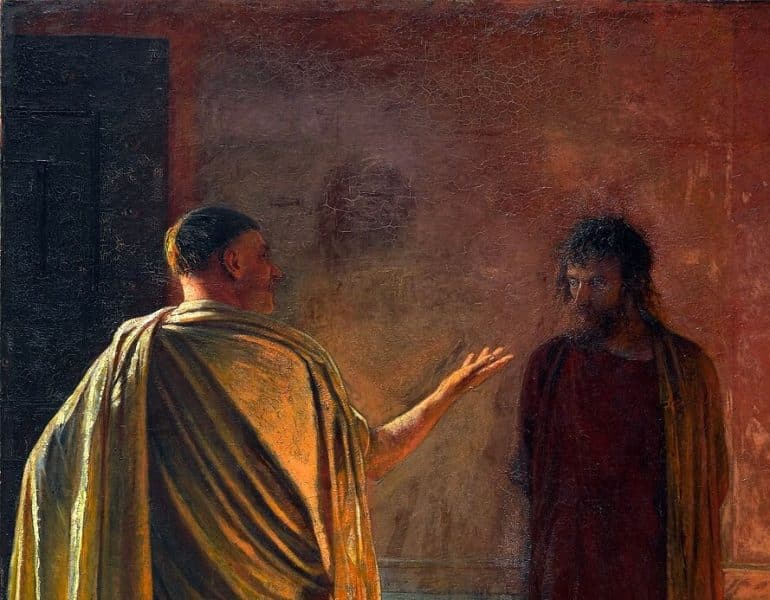
Above: “What is Truth?” Christ and Pilate, painting by Nicolai Ge (1831-1894). (cropped) [Information about copyright at [https://commons.wikimedia.org/wiki/File:What_is_truth.jpg]

The human intellect has not only the power of abstract understanding (which was discussed in Part I of this article), but also the power of judging the truth and falsehood of propositions. It has been argued by philosophers since antiquity that this power, too, goes beyond the capacities of purely physical or mechanistic systems.
The issue is this: If my thoughts follow a path set out for them by the forces of matter, how does the truth or falsehood of my ideas make any difference? In the final analysis, my thoughts, for better or worse, are just those that I must have given the motions of the atoms and other physical constituents of my brain. My judgments come not from my being reasonable or unreasonable but are forced upon me by material forces that are utterly blind to the truth or falsehood of the propositions that I am considering. As the great mathematician Hermann Weyl put it,
“[There must be] freedom in the theoretical acts of affirmation and negation: When I reason that 2 + 2 = 4, this actual judgment is not forced upon me through blind natural causality (a view which would eliminate thinking as an act for which one can be held answerable) but something purely spiritual enters in.” 11
He goes onto explain that if our thinking is to be rational it must not be entirely determined by merely physical factors such as the movements of particles in one’s brain — in which case it would be “groundless” and “blind” — but must be “open” to meaning and truth.
Writing in the same year (1932) the famous biologist J.B.S. Haldane argued, “If materialism is true, it seems to me that we cannot know that it is true. If my opinions are the result of the chemical processes going on in my brain, they are determined by chemistry, not the laws of logic.” 12 In Orthodoxy, his brilliant defense of Christianity written in 1908, G.K. Chesterton noted that the materialist skeptic must sooner or later ask, “Why should anything go right; even observation and deduction? Why should not good logic be as misleading as bad logic [if] they are both movements in the brain of a bewildered ape?” 13 Stephen Hawking worried about the same issue in connection with the “theory of everything” that many physicists are seeking.14 A theory of physics that explained everything would have to explain why some people believed it and some people did not. Their belief (or disbelief) in the theory, then, would be the result of inevitable physical processes in their brains rather than being a result of the validity or invalidity of the arguments made in behalf of the theory.
Arguments that minds cannot be rational if they are totally determined by material forces go back to antiquity. For example, Epicurus wrote, “He who says all things happen of necessity cannot criticize another who says that not all things happen of necessity. For he has to admit that the assertion also happens of necessity.” 15 (Of course, the necessitarian could always make the clever comeback that not only can he criticize, but he must criticize — of necessity. However, Epicurus’s point, presumably, was that the criticism, if it was compelled by physical necessity, would not then be rational criticism.)
Can a machine judge truth?
Haldane recanted his argument in 1954 because of the development of computers.16 He was impressed by the fact that although a computer is made only of matter and obeys the laws of physics it is nonetheless capable of operating in accordance with truth. However, Haldane was wrong to recant, since the example of the computer does not really resolve the question that he originally raised. It is true that a calculating device can print out “2 + 2 = 4”, or some equivalent formula, and in that sense can operate in accordance with the truth. However, its ability to do so is not to be sought simply in the laws of physics that it obeys. A calculating device (also obeying, of course, the laws of physics) could just as easily be constructed that printed out “2 + 2 = 17.” In fact, it would be even easier to build a device that printed out complete gibberish. The reason that most calculating devices do operate in a manner consistent with logic and mathematical truth is that they were programmed to do so. That is, they have built into them a precise set of instructions that tells them exactly what to do at every step. These programs are the products of human minds. More precisely, the acts of understanding that lie behind these programs took place in human intellects. Rather than illustrating, therefore, how an automatic device can give rise to intellect, artificial computers merely show that an intellect can give rise to a device. Not only do the design and programming of these devices occur as the result of human acts of understanding, but the meaning of their outputs can only be apprehended by human acts of understanding, not by the machines themselves. (These outputs can indeed be used by other machines, but only by machines designed to be able to do so by human intelligence.)
The mystique of the high-performance computer can obscure what is really going on. Let us therefore consider instead a humbler device, a vending machine. A vending machine contains a simple computing device that enables it to make change correctly. In spite of this, we do not attribute intelligence to vending machines. On the other hand, we might well attribute a great deal of intelligence to a child who was able to figure out for himself or herself how to make change correctly. What is the difference? The difference is that the child understands something and the vending machine does not. Of course, the vending machine could not do what it does without intelligence being involved somewhere along the line. At some point there was an understanding of numbers and the operations of arithmetic; there was an understanding of how to perform these operations in a routine fashion; and finally there was an understanding of how to build a machine to carry out these routine steps automatically. All of these acts of understanding took place in human intellects, not in vending machines. The point at which any task has become routinized, so that it no longer requires acts of understanding, is the point at which it can be done by a machine which lacks intellect.
The question raised by progress in developing computer hardware and computer programs is whether a sufficiently advanced computer could have genuine intellect, and whether in fact the human intellect can be explained as being the performance of an enormously powerful biological computer, the brain. When we “understand” that some proposition is true, is no more going on than that our brains are following some canned instructions, some very complex but routine procedure? Let us suppose for the sake of argument that this is so and see where it leads us.
A number of difficult questions would then arise. First, how is it that humans can know, as sometimes at least we do know, that our thought processes are reasonable and consistent? One of the implications of Gödel’s Theorem is that no computer program (except a very trivial one) that operates consistently is able to prove that it does so. If we were merely machines operating in accordance with a program, then we could not be aware of our own consistency. Second, if our brains have in fact been programmed so that they can think consistently and reasonably, how did that happen?
If an electronic computer operates in a correct way, it is because some human beings programmed it to do so. But who programmed those human beings to operate correctly so that they could impart that correctness to the electronic computer? The only answer available to the materialist (and the one suggested by Stephen Hawking, among many others) is natural selection. Natural selection programmed human beings to think in such a manner that our thoughts correspond in some way to reality. Obviously, an organism that could not think straight would be at a disadvantage in the struggle for survival. This answer is appealing at first sight; but it is not really adequate.
Certain knowledge and necessary truths
A major difficulty for the idea that the human mind is no more than a computer programmed by natural selection is the fact that it has two remarkable abilities: (a) the ability to attain certainty about some truths, and (b) the ability to recognize that some truths are true of necessity. (These may seem like the same thing, but they are not. I am certain that my first name is Stephen, but it could have been something else, so that that is not a “necessary” truth. On the other hand, it is necessarily true that 147 x 163 = 23,961, in the sense that it could not have been anything else, and must be so in any possible universe; but someone who is not adept at multiplying large numbers might nevertheless be in a state of uncertainty about it.)
There are two aspects to this problem. In the first place, a creature’s “evolutionary success” (that is, its success in surviving to reproduce and in ensuring the survival of its offspring) does not require that it be able to know things with absolute certainty or that it be able to recognize truths as necessary ones. It is quite enough for it to have knowledge that is reliable for practical purposes and that is known to be generally true in the circumstances that it has to face. It does not have to know with absolute certainty that a branch will support its weight, that a fruit is not poisonous, or that a fire will burn it, in order to survive. It is quite enough for it to be 99.99% sure or even 90% sure. Nor is it of any use to it to understand that the statement “2 + 2 = 4” is true of necessity, and therefore true in any possible world. It would be just as good to know that 2 + 2 can be trusted to come out 4 in its own situation.
The second aspect of the problem is that even if it were helpful to their survival for human beings to have absolute certainty in some matters, or to realize that some things are true of necessity, there seems to be no way that natural selection could possibly have programmed us to have that kind of knowledge. Natural selection is based ultimately on trial and error. Various designs are tried out, including various designs of brain hardware and brain software, and those that give the best results on average tend to lead to more numerous offspring. However, trial and error cannot produce certainty. Nor, obviously, can it lead to conclusions about what is necessarily true.
In a popular book about the philosophical implications of modern science the author asked, in all seriousness, “Is it so inconceivable that a reality could exist in which 317 is not a prime number?” 17 The answer is, quite simply, yes. It is totally inconceivable, indeed absurd. I do not know of any scientist or mathematician who would admit any possibility of doubt about this. Not only is 317 prime here and now, it is indubitably prime in galaxies too remote to be seen with the most powerful telescopes. It was prime a billion years ago and will be prime a billion years hence. It would have to be prime in any other possible universe. However, there is no way that the processes of natural selection that operated upon our forebears could have had access to information about what will be true in a billion years, or in remote galaxies, or in other possible universes. How, then, can those physical processes have taught us these things, or fashioned us so that we could recognize them?
It is important to be clear about what the issue here is. The issue is not how we came to be able to do arithmetic and figure out whether 317 is a prime number. Having the abilities that enable us to figure out the rules that will give correct answers to arithmetical problems may indeed have advantages for survival. One could even imagine that by evolutionary trial and error the right circuitry was “hard-wired” into our brains to do arithmetic correctly. And, therefore, assuming that “317 is a prime” happens actually to be a necessary truth, it is not surprising that evolution allows us to arrive at conclusions which in fact happen to be necessary truths. The question, however, is this: How do we recognize that necessity? How and why did natural selection equip us, not merely to say that 317 is prime, but to recognize of that truth that it is true of necessity? 18
The reaction of some materialists to such an argument, I dare say, would be to suggest that human beings are not actually capable of achieving certainty about anything, or knowledge of the necessity of truths. In their view, all we can ever claim to have is knowledge that has a high probability of being right. When we say we are “certain”, we are, according to this view, only expressing a strong feeling of confidence in what we are saying. And when we say something is “true by necessity,” we just mean that we have not been able to imagine a contrary situation. Absolute certainty, according to many materialists, is a chimera.
This skeptical position has some superficial plausibility. After all, we have all had the experience of claiming to be certain about something only to find out later that we were mistaken. In spite of its initial plausibility, however, this account of what we mean by “being certain” is simplistic and untenable.
Consider the two statements, “The sun will come up tomorrow” and “317 is a prime number.” I have great confidence in the truth of both. But they are radically different types of statement, in which I have radically different types of confidence. I admit that it is overwhelmingly probable that the sun will come up tomorrow, but I do not believe that it is absolutely certain. It is quite conceivable that the sun will not come up tomorrow, and in fact there are scenarios, not excluded by anything that we know about the laws of nature, in which the sun would not come up tomorrow.
To take the most exotic such scenario, we could be in what particle physicists call a “false vacuum state.” That is, just as some radioactive nuclei with very long half-lives appear to be stable, but actually have a small chance of disintegrating suddenly and without prior warning, so the state of matter of our world may actually be unstable in the same way. It is possible that a large bubble of “true vacuum” — that is, a state of lower energy — will suddenly appear in our vicinity by a “quantum fluctuation.” If it does, it will expand at nearly the speed of light and destroy all in its path. We would never know what hit us. The sun would not come up tomorrow, because the sun would have ceased to exist. (No particle physicist loses even a moment’s sleep over this possibility, but none would claim that it is absolutely ruled out either.)
There are less exotic possibilities that also are not excluded by what is presently known about physics and that would prevent the next sunrise. And, aside from natural catastrophes, there is always the logical possibility of a miracle. The earth might miraculously stop rotating on its axis or the sun might miraculously disappear. As the philosopher David Hume pointed out, one cannot rigorously deduce what will happen in the future from what has happened in the past. Therefore, the skeptical materialist is right about this case: when we say we are “certain” that the sun will come up tomorrow, what we really mean is that we have an extremely high degree of confidence that it will.
However, it is far otherwise with “317 is a prime number.” No scientific phenomenon, however exotic, can make 317 not be a prime. The mediaeval theologians would have said that even the omnipotence of God could not do that.19 This is not just a question of something that is very highly probable, but of something truly certain. Someone might object that 317 is a fairly large number, and that the calculations which show it to be prime are too complicated to allow him to be certain about them. However, one can always take a case where this is not an issue, like “1 does not equal 0.” I think most people would admit to knowing this with certainty, and not simply to having a lot of confidence in it.
Moreover, the idea that our certainty about such things as “317 is prime” is simply a sort of gambler’s confidence, a confidence born of practical experience, simply does not bear careful scrutiny. I have seen that the sun came up about twenty-five thousand times without fail; whereas in the last twenty-five thousand arithmetical calculations I have done, I have not always gotten consistent answers. In fact, on many occasions I have not. If anything, then, my confidence that the sun will come up tomorrow ought to be greater than my confidence in the consistency of arithmetic.
However, our confidence in arithmetic is in fact stronger than our confidence in the sun coming up. Why? Is it based on some logical analysis? But that just raises the question of how it is that we have the confidence we do in the consistency of logic.
Even if one were to concede that our certainty is never absolute (which I am not prepared to do) it would still remain the case that we have a certainty about some kinds of truths that far exceeds what we can derive from trial and error, and which it is very hard to explain as arising from natural selection.
It is still open to the materialist to retreat to an even more skeptical position. Yes, he might concede, we do actually have the conviction in some cases that we know something with absolute certainty or know that something is true of necessity. But perhaps all such convictions are just illusions or feelings implanted in us by Nature. They are chemical moods, so to speak. For some reason our brains were fashioned by natural selection to have these feelings of certainty because they help us get through life. In Chesterton’s phrase, they are just movements in the brain of a bewildered ape. This is a possible position, but it means, ultimately, abandoning all belief in human reason. I would rather take my stand with the great mathematician G.F. Hardy, who said, “317 is a prime number, not because we think it so, or because our minds are shaped in one way rather than another, but because it is so, because mathematical reality is built that way.” 20 And with Galileo, who said, “It is true that the divine intellect cognizes mathematical truths in infinitely greater plenitude than does our own (for it knows them all), but of the few that the human intellect may grasp, I believe that their cognition equals that of the divine intellect as regards objective certainty, since man attains the insight into their necessity, beyond which there can be no higher degree of certainty.” 21
Another remarkable power of the human mind
I have cited the capacity to understand universals, or abstract concepts, openness to truth, the ability to attain certainty, and the power to recognize that some truths are true “of necessity,” as being beyond the capacity of any merely material system, including the kind that the materialist conceives us to be — a computer programmed by natural selection. Another human intellectual ability involves all of these at once, namely the power to recognize that some truths hold in an infinite number of cases. Roger Penrose gives the following example.22 We all know that 3 x 5 = 5 x 3. As Penrose notes, mathematically speaking this is not the empty statement it appears to be. It really says that three groups of five objects and five groups of three objects contain the same number of objects. There is a simple pictorial argument that shows this: If we arrange fifteen objects in a three-by-five rectangular array, we see that it has five columns of three objects and three rows of five objects. Now, most of us, when we look at that array, will immediately “see” that the same thing works for a rectangular array of any size, so that a x b = b x a in general, for any whole numbers a and b.
The ability to “see” this is a remarkable thing, as Penrose points out. We are seeing at once the truth of an infinite number of statements. Exactly the same observation was made by St. Augustine in his philosophical work De Libero Arbitrio completed around 395 AD. In reference to a similar arithmetical statement he asked, “How do we discern that this fact, which holds for the whole number series, is unchangeable, fixed, and incorruptible? No one perceives all the numbers by any bodily sense, for they are innumerable. How do we know that this is true for all numbers? Through what fantasy or vision do we discern so confidently the firm truth of number throughout the whole innumerable series, unless by some inner light unknown to the bodily senses?” 23
This “inner light, unknown to the bodily senses” is nothing else than the human “intellect.” As noted at the beginning of Part I of this article, it is the powers of the human intellect together with the freedom of the human will that according to traditional Catholic teaching raise us above the level of the merely material and point to the existence in us of something immaterial, which is traditionally called the “spiritual soul” or “rational soul.” This is in no way contrary to science. Rather, nothing bears more eloquent testimony to the enormous power of the human intellect than science itself.
[This article is adapted from chapter 21 of the author’s book Modern Physics and Ancient Faith, University of Notre Dame Press (2003).]
References
11. Hermann Weyl, The Open World: Three Lectures on the Metaphysical Implications of Science (New Haven: Yale University Press, 1932), p. 31-32.
12. J.B.S. Haldane, The Inequality of Man (London: Chatto and Windus, 1932).
13. G.K. Chesterton, Orthodoxy (New York: Doubleday, 1959), p. 33.
14. Stephen Hawking, A Brief History of Time: From the Big Bang to Black Holes (London: Bantam, 1988), p. 12.
15. Cyril Bailey, Epicurus: The Extant Remains (Oxford: Clarendon Press, 1926).
16. J.B.S. Haldane, “I Repent an Error,” in The Literary Guide (April 1, 1954), 7, 29.
17. Kitty Ferguson, “The Fire in the Equations: Science, Religion, and the Search for God (Grand Rapids, MI: William B. Eerdmans Publishing Co., 1994), p. 63.
18. Arguments similar to the ones I am developing here have been put forward by Prof. Katherin Rogers of the University of Delaware.
19. St. Thomas Aquinas, Summa Theologiae, Part I, Question 25, art. 5.
20. G.H. Hardy, A Mathematician’s Apology (Cambridge: Cambridge University Press, 1940), p. 70 (quoted by Ferguson in The Fire in the Equations, p. 63).
21. Quoted by Weyl in The Open World, p. 10-11.
22. Roger Penrose, Shadows of the Mind: The Search for the Missing Science of Consciousness (Oxford: Oxford University Press, 1994), p. 55-8.
23. St. Augustine, On Freedom of the Will, trans. Anna S. Benjamin and L.H. Hackstaff (New York, Bobbs-Merrill, Co., 1964), Bk. 2, ch. 8.