

Science and the Soul. Part I: The Human Intellect and Abstract Thought.
 December 1, 2025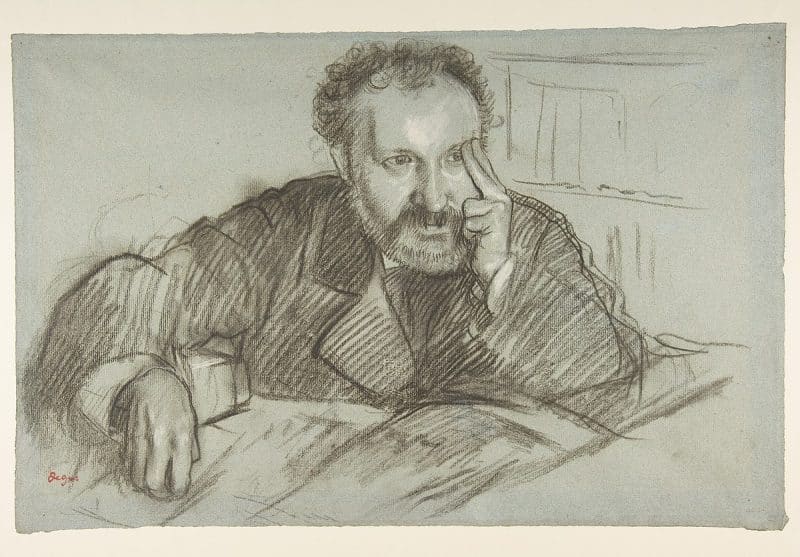
Above: “Edmond Duranty (1833-1880)” Drawing by Edgar Degas. [Copyright information at https://commons.wikimedia.org/wiki/File:Edmond_Duranty_(1833%E2%80%931880)_MET_DP813399.jpg]
Introduction
Many modern people think the idea of a “soul” is antiquated, superstitious, or silly, and most certainly unscientific. But do they really understand what is meant by the soul in Christian thought? Doubtless some of them associate it with images they saw as children in old cartoon shows, where whenever a character died a spectral copy of it floated free and rose into the clouds flapping its wings and holding a harp. The cartoon notion of the soul is that it is just another body, though made up of more ethereal ghostly matter. There were actually scientists in the past who tried to weigh the soul by comparing the weights of human beings just before and after death. On the same level of unsophistication, the atheist cosmologist Sean Carroll imagines that if there were a soul, it would have to be made of some kind of “spiritual particles.” Of course, these are silly ideas, but they have no relation to what the human soul is supposed by Christian thought to be.
What is characteristic of “spiritual” beings in Catholic philosophy and theology is that they possesses “intellect and will” and thus rationality and freedom. These powers were understood to transcend the capacities of anything that is purely material, from which it follows that there must be an aspect or component of a human being that is immaterial, i.e, not reducible to matter. This aspect or component of a human being has traditionally been called the “spiritual soul” or “rational soul.”
This article will focus on the human intellect and certain of its capacities and whether they can be explained in purely physical and mechanistic terms, as materialists believe, or whether they transcend the level of matter in some way.
Among the core capacities of the human “intellect” are conceptual understanding and rational judgment. The former is the ability to understand the meanings of abstract concepts and of propositions that contain them, while the latter is the ability to judge the adequacy of those concepts and the truth of those propositions. Correspondingly, the first part of this article will be about understanding abstract concepts, and the second part about judging truth.
Grasping the meaning of abstract concepts
What do we mean by concepts being “abstract”? That is perhaps easiest to get at by way of examples. If you think about a particular person, you are not thinking abstractly, but if you think about “persons” in general, you are. Abstract concepts such as “person”, “justice”, or “triangularity” are what the philosophers call “universals.” The word “triangularity,” for instance, is a universal because it does not refer to this or that triangular object but applies to all real or possible triangular objects. Indeed, it can be understood apart from any concrete example of triangularity. When we think of a universal apart from any particular object, we are engaged in truly abstract thought.
Abstract thought has, therefore, in a sense, an unlimited reach. It transcends what is here and now and the particularities of specific objects by the use of concepts that are infinite in scope. For this reason, a philosophical tradition that goes back at least to Aristotle1 has argued that nothing that is merely material can engage in abstract thought. It is true that a material system can exemplify — or in philosophical jargon “instantiate” — a universal; for instance, a piece of wood or slice of cake could have a triangular shape. But a finite material system cannot exemplify all ways of being triangular (for there are infinitely many different triangular shapes) and therefore could not encompass within itself the entire meaning of the concept “triangle.” Or consider the concept of a mathematical “curve.” Particular curves can be exemplified by, say, the shape of a bent piece of wire or the path of a projectile, but no finite material thing or system can exemplify at once all mathematical curves.
The argument is that the human brain, being a finite material system, cannot encompass within itself the whole meaning of an abstract concept. It may contain images that illustrate abstract concepts. It may even have words or symbols stored in it that “stand for” abstract concepts. But the meaning or content of an abstract concept cannot be contained in it. There must, therefore, be some non-material component to human minds that enables them to think abstractly.
What about non-human minds? The philosopher Mortimer Adler in his book Intellect maintained that there is no scientific evidence that any animal other than human beings can understand universals.2 He admitted that there are some facts that might suggest otherwise. For example, even some species of fish can distinguish between a square object and a circular object. However, this is not an example of true abstract thinking, according to Adler, but rather what he called “perceptual abstraction.” These fish can only recognize a circle when presented with a circular object. In other words, the “abstraction” is tied closely to a perceptual act. In contrast, human beings can engage in what Adler called “conceptual abstraction.” They can think about roundness or squareness in general, apart from any perceived object. They can relate such concepts to other concepts, make them mathematically precise, and even prove theorems about them.
At this point, a materialist might be tempted to object that computers can prove theorems also, and therefore (since computers are material objects) Adler must have been wrong. But this raises the question of whether a computer really “understands” what it is doing. It manipulates symbols, and those symbols mean something to the human programmer. But do they mean anything to the computer itself? Does it know whether the symbols it prints out refer to circles and squares rather than rocks and trees? Does it know that it is saying anything meaningful at all? The symbols or “bits” that it manipulates might stand (in somebody’s mind — but not the computer’s) for concepts, but the symbols and bits are not, themselves, concepts.
Some materialists might reply that a computer can understand, because “understanding” information means no more than being able to put that information to use, to act in appropriate ways on the basis of it. They might say that if a robot uses information from sensors to avoid bumping into a table, it “understands” (for all practical purposes) that the table is there. However, it would seem that abstract conceptual understanding is something more than this. There are many things that we understand that have no particular relevance to our behavior. We have insights that we cannot possibly put to practical use. If we understand something about the topology of shapes in six dimensions, for example, what is the appropriate behavior that follows from that understanding? We do not live in six dimensions.
The idea that a computer “understands” if it can make use of information would lead to rather bizarre conclusions. An ordinary door lock has “information” mechanically encoded within it that allows it to distinguish a key of the right shape from keys of other shapes. It uses that information to react in an appropriate way when the right key is inserted into it and turned: the lock mechanism pulls back the bolt and allows the door to open. Does the lock understand anything? Most people would say not. While the lock, in a sense, could be said to “recognize” the right-shaped keys, it does not understand shapes any more than the fish understands shapes. Neither of them can understand a universal concept. However, some materialists do believe that even very simple non-living physical systems have mental attributes. For example, the man who invented the phrase “Artificial Intelligence,” John McCarthy, wrote that “machines as simple as thermostats can be said to have beliefs.” 3
In talking about thermostats, McCarthy was not choosing an example at random. A thermostat can be thought of as a very simple brain. For, just as an animal’s brain receives information about the world around it from sensory organs, a thermostat has a sensor that tells it what the temperature is in some particular locale, such as the living room of a house. And just as an animal’s brain controls a body, telling it how to react to its environment, a thermostat controls some apparatus, usually a heating or cooling device. We could say, then, that a thermostat “senses” one feature of its environment and responds to it. And we therefore could, in some very broad sense, attribute to thermostats “sensation”, “perception”, and even “cognition.” However, it remains the case that a thermostat cannot understand universal concepts or abstract ideas. To put it succinctly, a thermostat does not understand Thermodynamics.
What are abstract concepts?
The argument up to this point has been that materialism has a hard time accounting for how the human mind can understand the “meaning” of abstract concepts or “universals,” because universals have an infinite scope, so to speak, whereas material systems, including the human brain, are finite.
But there is an even more basic question for materialism: what are abstract concepts? Let us address this in the context of mathematics, where the abstract concepts are relatively precise and clearly defined. Let us start with something seemingly quite simple, the concepts called “counting numbers,” and to be specific the number 4.
One thing that is obvious is that the number 4 is not a material object. But perhaps it can be understood as a feature or aspect of material objects. The number 4 itself is not made of matter, but a 4-sided table is, and 4 rocks are, and a 4-footed animal is. In this view, when we think about “4”, we are really thinking about things or groups of things in the physical world that, in some way, have four-ness about them.
While this view is plausible for small counting numbers like 4, it runs into serious difficulties when it comes to other kinds of numbers, such as pi. One can have 4 cows, but one cannot have pi cows; and one can have a 4-sided table, but not a pi-sided table. Of course, in a sense, one can have a pi-sided table: a circular table whose diameter is one meter will have a circumference of pi meters. So could pi be thought of as simply a property of material objects, and specifically of objects that are circular?
This seems to be a common idea. If you ask “the man in the street” what pi is, he might give you this answer. But in reality it will not do. One problem with it is simply that there are no exactly circular objects in the physical world; and for an object that is not exactly circular, the ratio of circumference to diameter is not pi (except for very special shapes that are as unlikely to exist in Nature as exact circles). It might be close to pi, but close to pi is not pi, at least not the mathematician’s pi. Nevertheless, pi does at least have some connection to shapes that we see approximated in the physical world. However, most numbers do not have even this link to the world of matter. Consider, for example, the number 0.1011001110001111000011111… . (The pattern is clear: one 1, one 0, two 1’s, two 0’s, three 1’s, three 0’s, etc.) This is a definite well-defined number, but it has no connection to any shape or figure that one will find in the physical world. Nor will most other numbers, such as the 17th-root of 93.
The materialist is left with a problem. If numbers and other mathematical concepts are neither material things nor even just aspects or properties of material things, then what are they? The only answer open to him would seem to be that they are mental things, things that exist in minds. Mathematics is, after all, a mental activity. This however, raises the question of what a “mind” is and what “mental things” are.
To the non-materialist, minds and the ideas they contain can be real without being entirely reducible to matter or to the behavior of matter. To the materialist, however, there can be nothing to our minds besides the operations of our central nervous systems. In the memorable words of Sir Francis Crick, “you are nothing but a pack of neurons.” 4 Consequently, to a materialist, it follows that “an explanation of the mind … must ultimately be an explanation in terms of the way neurons function,” to quote Sir John Maddox, the former editor of the scientific journal Nature.5 Now, if we say that abstract concepts, such as the number pi, exist only in minds, and if we also say, with the materialist, that minds are only the functioning of neurons, then we are left in the strange position of saying that abstract concepts are in themselves nothing but patterns of neurons firing in brains. Not, mind you, merely that our neurons fire when we think about or understand these concepts, or that the firing of neurons plays an essential role in our thought processes, but that the abstract concepts about which we are thinking are in themselves certain patterns of neurons firing in the brain, and nothing but that. Indeed, a book review some years ago contained the statement, “Numbers are … neurological creations, artifacts of the way the brain parses the world.” 6 The author of that statement was summarizing the views of a “cognitive scientist” who had written a book subtitled “How the Mind Creates Mathematics” (by which he really meant, of course, “how the human central nervous system creates mathematics”).7
To the consistent materialist, then, the number pi can be nothing else than a pattern of discharges of nerve cells. It has no more status, therefore, than a toothache or the taste of strawberries. This is a notion that many people who deal extensively with abstract mathematics would have a hard time accepting. The number pi appears to the mathematician as something more than a sensation or a neurological artifact. It is not some private and incommunicable experience, like a toothache; it is a precise, definite, and hard-edged concept with logical relationships to other equally precise concepts. It is something that can be calculated with arbitrary precision — as of March 2024 it had been calculated to 105 trillion decimal places. It has remarkable and surprising properties, which the mathematician feels that he is discovering rather than generating neurologically.
To take just a few examples, the sum of the infinite series of fractions 1 – 1/3 + 1/5 – 1/7 + 1/9 – 1/11 + … is exactly pi/4, and the sum of the infinite series 1 + (1/2)2 + (1/3)2 + (1/4)2 + … is exactly (pi)2/6. But what are these precise and beautiful mathematical statements? According to the consistent materialist they too are “neurological creations.” Not only pi itself, but the statement “1 – 1/3 + 1/5 – 1/7 + 1/9 – 1/11 + … = pi/4” is no more, ultimately, than a pattern of neurons firing in someone’s brain. The neurons firing in someone’s brain in a certain way may lead him or her to write certain figures on a piece of paper or blackboard (like the formula “1 – 1/3 + 1/5 – 1/7 + 1/9 – 1/11 + … = pi/4”), and those shapes on paper or blackboard may in turn stimulate the neurons in someone else’s brain to fire in certain patterns. But whether it is patterns of ink on paper, of chalk on blackboard, or of neurons firing in brains, concepts, to the consistent materialist, are just patterns that exist in some material system.
Some materialists might be tempted to explain their position by saying that these physical patterns on paper or in the brain “mean” something. However, to say that a pattern “means” something is to say that it stands for some ideas: meanings are ideas that are understood by minds. And from the materialist’s point of view to say that a “meaning” is being “understood” by a “mind” is ultimately to say no more than that some pattern of electrical impulses is occurring in a brain. The materialist cannot go beyond patterns to the “meanings” of patterns, because meanings themselves are ultimately nothing but patterns in brains.
I have used the number pi as an example, but I could have used any other abstract concept, whether mathematical or not. However, since mathematics is the realm of the purest abstract thought, and is also the language of physical science, it is particularly relevant to our discussion. For, if we reduce mathematical ideas to neurons firing, we reduce all of scientific thought to neurons firing. What is the Theory of Relativity? What is Quantum Theory? What is the Schrödinger Equation? What are Maxwell’s Equations of electromagnetism? Just neurons firing? What are the statements theoretical physicists make, like “Observables are Hermitian operators acting in a Hilbert space,” or “All Cauchy surfaces for a spacetime are diffeomorphic,” or “Spontaneously broken gauge theories are renormalizable”? Nothing but patterns of nerve impulses? Squiggles on a page? It is the absurdity of this kind of conclusion that was the basis of the incisive critique of materialism made by Karl Popper, the eminent philosopher of science, especially in his later works.8
Most people do not like mathematics and physics much and perhaps would be just as happy to think of them as some quirky phenomena occurring in the nervous systems of a small number of peculiar people. (Not surprisingly, most mathematicians and theoretical physicists do not share this view.) But it is not just the concepts of mathematics and physics that are at stake here; all concepts are at stake, including those of biology, neuroscience, and indeed the concepts of the cognitive scientist I just mentioned who thinks that numbers are “neurological creations.” Cognitive scientists talk about neurons, for example. But “neuron” itself is an abstract concept that arose from the researches of biologists. For the materialist, then, even the concept of “neuron” is nothing but a neurological creation; it also is a pattern of neurons firing in someone’s brain. If this sounds like a vicious circle, it is. We explain certain biological phenomena using the abstract concept “neuron” and then we proceed to explain the abstract concept “neuron” as a biological phenomenon — indeed, a biological phenomenon produced by the activity of neurons. What we are observing here is the snake of theory eating its own tail, or rather its own head. The very theory which says that theories are neurons firing is itself naught but neurons firing.
This is an example of what G.K. Chesterton called “the suicide of thought.” 9 All of human understanding, including all of scientific understanding, is reduced to the status of electro-chemical processes in an organ of the body of a certain mammal. In the words of a Newsweek article, “Thoughts … are not mere will-o’-the-wisps, ephemera with no physicality. They are, instead, electrical signals.” 10
Why should anyone believe the materialist, then? If ideas are just patterns of nerve impulses, then how can one say that any idea (including the idea of materialism itself) is superior to any other? One pattern of nerve impulses cannot be truer or less true than another pattern, any more than a toothache can be truer or less true than another toothache.
[This article is adapted from chapter 21 of the author’s book Modern Physics and Ancient Faith, University of Notre Dame Press (2003).]
References
1. According to Aristotle, the human mind, in contrast to the minds of non-rational animals, has an immaterial component, which he called the active intellect (Nous). “The active intellect abstracts forms from the [mental] images or phantasmata, which, when received into the passive intellect, are actual concepts.” Frederick J. Copleston, SJ, A History of Philosophy, Vol. 1, Pt. II, p. 71.
2. Mortimer J. Adler, Intellect: Mind over Matter (New York: Macmillan Publishing Co., 1990), ch. 4.
3. John McCarthy, “Ascribing Mental Qualities to Machines,” in Philosophical Perspectives on Artificial Intelligence, ed. Martin Ringle (Atlantic Highlands, NJ: Humanities Press, 1999).
4. Francis Crick, The Astonishing Hypothesis: The Scientific Search for the Soul (New York: Charles Scribner’s Sons, 1994), p. 3.
5. John Maddox, What Remains to be Discovered: Mapping the Secrets of the Universe, the Origins of Life, and the Future of the Human Race (New York: The Free Press, Simon and Schuster, Inc., 1998), p. 281.
6. George Johnson, “Does the Universe Follow Mathematical Law?”, The New York Times, Feb. 10, 1998.
7. Stanislas Dehaene, The Number Sense: How the Mind Creates Mathematics (Oxford: Oxford University Press, 1997).
8. J.C. Eccles and K.R. Popper, The Self and Its Brain (New York: Springer, 1977); K.R. Popper, Knowledge and the Mind-Body Problem: In Defense of Interaction (London: Routledge, 1994).
9. G.K. Chesterton, Orthodoxy (New York: Doubleday, 1959), p. 3.
10. Sharon Begley, “Thinking Will Make it So”, Newsweek, April 5, 1999, p. 64.