

The Glory of the Logoi: What the New Biology Reveals About Life’s Purposefulness
 May 20, 2026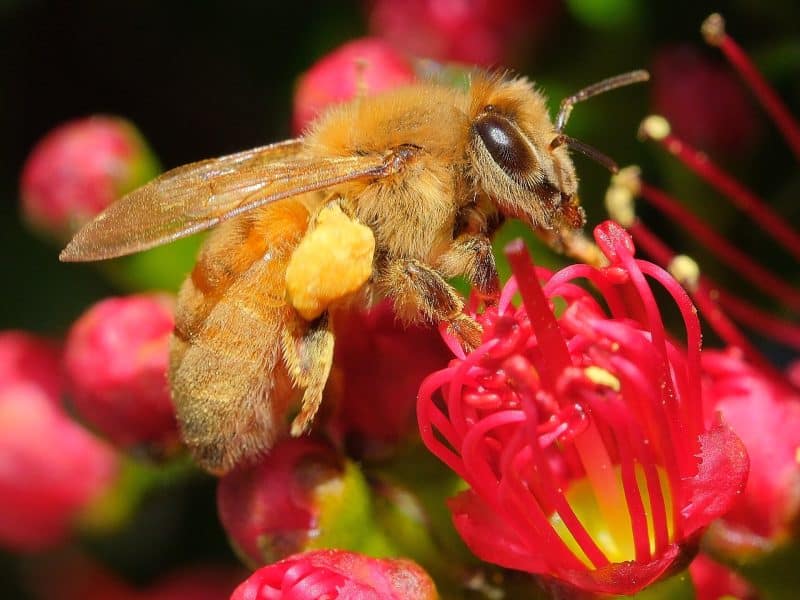
Above: Bee with full pollen sack on top of rata flower.[https://commons.wikimedia.org/wiki/File:Bee_on_top_of_rata_flower.jpg]
“There is one glory of the sun, and another glory of the moon, and another glory of the stars: for one star differeth from another star in glory.” (1 Cor. 15:41) Living things too have a splendor of their own, bound up with their remarkable purposefulness, their capacity to direct themselves toward their own ends as genuinely self-directing wholes. Captivated by its own undeniable achievements, the dominant biology of the past century has hidden this light under a bushel. The New Biology is beginning to let it shine again.
The molecular biology revolution and the modern synthesis transformed twentieth-century science, but also reduced organisms to their genes. Richard Dawkins’s declaration that “we are survival machines — robot vehicles blindly programmed to preserve the selfish molecules known as genes” and E.O. Wilson’s claim that “the organism is only DNA’s way of making more DNA” are among its most memorable expressions, but the attitude runs far deeper than any particular formulation. C.S. Lewis had a name for this kind of rhetorical move: “nothing buttery” — the tendency to say that X is nothing but Y. An organism is nothing but its genes. An animal is nothing but an automaton. This was Descartes’s considered view. It rested on the deliberate philosophical choice to eliminate formal and final causes from natural philosophy, which left only the material and efficient.
Formal causes, in the Aristotelian framework, are not merely the external shape of a thing but what makes a thing what it is: its organizing principle, the active source of its characteristic powers. Final causes, or teleology, refer to how things are directed toward ends or goals. Modern science followed Descartes in banishing them, but the exile was never fully enforced. J.B.S. Haldane is famously quoted as saying that “teleology is like a mistress to a biologist: he cannot live without her, but he’s unwilling to be seen with her in public.” Goals and purposes pervade even the language of molecular biology: nitrogenase is for fixing nitrogen; RuBisCO is for fixing carbon. But beyond this more trivial sense of purpose, when we observe a single-celled predator like Lacrymaria extending its slender neck many times its own body length to hunt prey, sampling the surrounding water systematically and paralyzing what it catches with discharged toxins, it is sobering to be reminded that a single cell is coordinating genes and their products toward its own ends.
A series of developments in the life sciences over the past several decades are forcing a reassessment of what organisms are and how evolution works, restoring the glory of the living world beyond the nothing buttery of the Old Biology.1 The study of convergent evolution suggests that the history of life has a genuine directionality, one that sits uneasily with the view that evolution is an open-ended, contingency-driven process. Work in molecular and developmental biology has revealed organisms as active managers of their own genetic resources rather than passive vehicles for selfish genes. And studies of bioelectricity have shown that cells and tissues operate as goal-directed collectives, navigating toward target body plans by flexible means. That picture resonates deeply with the Aristotelian tradition, and, as we will see, with the theological vision of St. Augustine and St. Maximus the Confessor.
Convergence and the Shape of Evolutionary History
For most of the twentieth century, the standard view held that evolutionary history was radically open-ended — the particular forms life has taken were largely the product of chance. But independent lineages have repeatedly arrived at the same solutions. Open-water predators as different as dolphins, ichthyosaurs, and sharks all converged on the same streamlined body plan because the physics of moving efficiently through water admits only a narrow range of viable forms. Birds, pterosaurs, and bats independently evolved powered flight on wings derived from forelimbs, because the aerodynamic requirements are equally constraining. The camera eye appeared separately in vertebrates and octopuses, and in several other unrelated lineages, because the optics of focusing light on a photosensitive surface have only a few good solutions. Evolution keeps finding the same answers because the problems — set by the physics of air, water, and light — stay the same.2
The evolutionary palaeobiologist Simon Conway Morris has written extensively about this, arguing that it reveals a genuine directionality in the history of life. His argument is a direct challenge to Stephen Jay Gould’s famous claim that if you rewound the tape of life, the outcome would be wholly different — that humans would not appear again. What makes the dispute particularly pointed is that Gould and Conway Morris were both working from the same evidence: the Burgess Shale, a remarkable Cambrian fossil deposit in the Canadian Rockies. Gould interpreted its exotic extinct forms as evidence of radical contingency — the survivors were lottery winners, and a rerun would produce an entirely different biosphere. Conway Morris, who had done much of the original fossil reconstruction, interpreted the same evidence differently: even among those strange Cambrian creatures, he found evidence of convergence and constraint.3 The space of viable biological forms appears to be far smaller than Gould supposed.
As the saying goes, natural selection can explain the survival of the fittest, but not the arrival of the fittest. If viable forms are rare solutions in a vast space of possibilities, the question of how they are arrived at cannot be answered by the random single-point mutations the standard model has relied on. Changing one base pair at a time is a poor strategy for reaching new functional structures that often require many coordinated changes simultaneously. The waiting time problem makes an aspect of this difficulty explicit: given realistic mutation rates and population sizes, the standard model cannot account for how fast genuinely new forms appear in the fossil record. Before we can turn to where new forms come from, we must understand what the genome is actually for and how it is used.
The Organism and Its Genome
The Old Biology took the genome to be the program, the linear instructions the cell executes. Consider an observation the gene-centric view struggles to account for: the human genome contains roughly twenty thousand protein-coding genes. So does the genome of C. elegans, a nematode with fewer than a thousand cells in its entire body. Complexity does not scale with gene number, suggesting that the difference is not which genes are present but how they are regulated. The genome is better understood as a resource the cell draws on toward a purpose. What gets expressed is the outcome of many things happening at once — chromatin state, signaling history, neighboring cells, the cellular environment — none of them issuing instructions on its own. The activities of cells, tissues, and organisms emerge from how these come together.
DNA is packaged around histone proteins into a three-dimensional structure of loops and domains that the cell continuously remodels: chemical modifications to histones open or condense chromatin, determining which genes are accessible, while direct methylation of DNA silences specific sequences. The same region can shift between accessible and inaccessible depending on the cell’s state. Spatial organization extends beyond chromatin itself. Much of the cell’s regulatory machinery — transcription factors, RNA, processing enzymes — gathers into membraneless droplets formed by liquid-liquid phase separation, transient compartments that concentrate the right molecules at the right place and time. These biomolecular condensates are increasingly understood as a way the cell integrates signals and makes decisions. A phase transition can sharpen a graded input into a thresholded response, decision-making implemented in the physics of the cytoplasm itself. What gets transcribed is not simply a matter of which sequences are present in the genome but of the cell’s dynamic spatial organization at any given moment — a state that shifts in response to development, physiology, and environment.
Transcription factors are proteins that bind to regulatory regions of the genome (such as promoters, enhancers, and silencers) to activate or repress specific genes. They interact in gene regulatory networks of considerable complexity, with feedback loops, cascades, and modular circuits that can be independently tuned. Small changes in these networks can produce large changes in body form. The Hox genes are the canonical illustration. A highly conserved set of transcription factors, the Hox genes specify regional identity along the body axis, activating particular combinations of downstream genes in the head, thorax, abdomen, and so on. A fruit fly, a mouse, and a human share essentially the same Hox genes. What differs is how and where they are deployed. Each Hox gene has its own regulatory regions. The particular combination of transcription factors a cell produces at a given moment determines which Hox genes get activated in that cell, and so which body region forms there. The insight from evolutionary development (evo-devo) is that a relatively small number of regulatory changes can produce dramatic morphological differences, because the network amplifies small upstream variations into large downstream consequences.4
Beyond transcription itself, a single gene can generate many distinct proteins by combining its exons (protein-coding segments) in different ways through alternative splicing. Large portions of the genome produce regulatory RNAs that are never translated at all. Instead, they degrade messenger RNAs, block ribosomes, or modify chromatin. Even the proteins that are translated are not fixed in their roles. Aconitase functions as a metabolic enzyme in the mitochondria and as an iron-responsive regulatory protein in the cytoplasm, and the same crystallins that give the transparent lens of the vertebrate eye its optical properties are active metabolic enzymes elsewhere in the body, doing housekeeping work that has nothing to do with vision. These moonlighting proteins do what the cellular context calls for. The genome encodes far more information than any linear reading of its sequence would suggest, and even that information underdetermines what each of its products will do.
The cell itself is also actively regulating its activities by sensing its environment, integrating signals from multiple sources, and deciding which genes to express and when. The biologist Alfonso Martinez Arias has argued that we should be studying cell regulatory networks, not only gene regulatory networks: the cell as a fundamental unit of decision-making, with the genome as one resource among several that it draws on.5 There are also forms of inheritance that bypass the genome entirely. The spatial organization of the cell cortex in certain single-celled organisms is transmitted directly from parent to daughter. The inherited pattern carries information that the genome itself does not specify. Mitochondria are passed along as entire organelles, with their own genome and their own internal organization. Epigenetic marks on chromatin survive cell divisions. The genome is one channel of inheritance among several. Taken together, these layers describe a system in which the organism actively manages its own genetic resources and passes on information through channels beyond the genome itself.
Reshaping the Genome
Organisms go beyond simply managing their genomes. They reshape them, drawing on capacities long mistaken for junk DNA. Transposable elements (transposons), which are colloquially known as “jumping genes,” were long held up as the paradigm case of selfish DNA — sequences whose sole function was thought to be making more copies of themselves. They make up roughly half the human genome, but even these turn out to have been extensively domesticated by the organism. Barbara McClintock, who won the Nobel Prize for their discovery, preferred to call them “controlling elements” to emphasize their regulatory role, because transposons can be repurposed as the very regulatory elements already described: promoters, enhancers, and silencers, or be incorporated as protein-coding exons. James Shapiro calls this suite of capacities “natural genetic engineering,” which reflects that the organism is not a passive substrate for random mutation but an active agent reshaping its own genome.
McClintock had already intuited what Shapiro has since articulated as a fuller framework. In her Nobel lecture, when speaking of the cell’s ability to detect chromosomal damage and repair it, she referred to its apparent capacity to make “wise decisions.” Her stated goal for future research was to understand “the extent of knowledge the cell has of itself” and how it utilizes this knowledge “in a thoughtful manner when challenged.” Although she was careful not to attribute consciousness to the cell, her language pointed toward what the Old Biology has consistently tried to explain away: the organism as active agent, not passive vehicle.
Natural genetic engineering bears directly on the waiting time problem. If mutation were purely random, the odds of assembling a new functional protein from scratch would be prohibitive. But organisms show systematic mutational biases: which regions of the genome mutate and at what rates are partly under organismal influence. Moreover, the same transposons described above are activated preferentially under conditions of stress, concentrating genomic restructuring precisely when adaptation is most urgently needed. And transposons do more than modify regulatory elements, consequential as those modifications are for body form. They can also mediate domain shuffling, recombining exons from different genes to produce proteins with novel combinations of functional domains. These kinds of alterations are a far more generative source for the arrival of the fittest, with the organism as active participant, than a model that attributes most change to passive single-point mutations.6
Natural genetic engineering operates within the constraints of the genome’s three-dimensional organization, and can alter that organization at the largest scale by reshaping the karyotype — the full chromosomal architecture of a species, which determines not just chromosome number but where genes are physically located relative to one another. Transposons are among the agents of chromosomal inversions, translocations, and fusions, meaning natural genetic engineering can contribute to restructuring this large-scale architecture. Karyotypic differences between species are well documented: human chromosome 2 appears to be the result of a fusion of two ancestral chromosomes that remain separate in chimpanzees, giving humans 46 chromosomes to the chimp’s 48. Such differences are a primary barrier to fertile hybridization. Henry Heng has proposed that dramatic karyotypic reorganizations — “genome chaos” — are the engine of macroevolutionary transitions: new body plans arise not through the slow accumulation of point mutations but through rare, wholesale restructurings of genomic architecture, after which microevolutionary refinement proceeds within the new configuration.7 The framework makes direct sense of punctuated equilibria: the long periods of stasis interrupted by sudden jumps that the fossil record shows and that gradual mutation struggles to explain. Sexual reproduction conserves the established karyotype by filtering aberrant configurations through meiosis, which is why species are stable once formed and why karyotypic transitions, when they occur, are rare and dramatic.
The Cell as Agent
The picture of the cell as active agent has a longer history than recent biology alone. At the end of the nineteenth century, Hans Driesch separated the first two cells of a developing sea urchin embryo and found that each developed into a complete, normal — if smaller — sea urchin rather than half an embryo. The machine model of the organism predicted the latter. Driesch coined the term equifinality to describe what he had observed: the same end state reached by many different means. He could not account for it mechanically, and so he turned to vitalism, declaring an answer before the phenomenon had been properly understood. The backlash against vitalism was largely justified, but in rejecting it biology also rejected the phenomenon. Lost with the metaphysical excess was the genuine observation: organisms do pursue fixed ends through flexible means, and no purely mechanical account has adequately explained this. The organicist tradition has been a minority current in twentieth-century biology, recovering this insight without the vitalist metaphysics.8 The New Biology now provides empirical vindication for what the organicists long argued.
Some of the most striking demonstrations of this principle, strange as they are, come from Michael Levin’s lab at Tufts University. When the face of a tadpole is completely scrambled — with facial features grafted to wrong positions — the organism proceeds to remodel the structures into a normal tadpole head.9 The organism knows, in some operative sense, what its target morphology is supposed to be, and reaches it by whatever route is available. When an eye is grafted onto the side of a tadpole with the original eyes removed, that ectopic eye develops an optic nerve that connects to the brain. The organism accommodates the radical anatomical perturbation in service of its own functional integrity.
What underlies this remarkable flexibility is partly bioelectricity: the electrical signals generated by ion channels and pumps across cell membranes, arising from the selective transport of ions like sodium, potassium, and calcium. It has long been known that such signals are not limited to nerve and muscle cells. Bioelectric gradients play established roles in cell proliferation, migration, and differentiation, and in organizing development into spatially coherent patterns. Levin’s work has shown that these signals encode body-plan information — cells and tissues maintain a bioelectric map of the organism’s target morphology and use it to coordinate collective behavior toward that target.
Using microinjected mRNA for specific ion channels, Levin’s team has induced the formation of an entire eye in regions of a tadpole embryo that would not normally form one, purely by altering bioelectric patterns, without directly manipulating genes for eye development.10 By altering bioelectric signals in planaria (flatworms), they have induced the formation of heads characteristic of entirely different species.11 The worm’s cells follow a body-plan blueprint encoded in the bioelectric pattern rather than the genome. Bioelectricity, on this view, is a layer of information above the genome, guiding how genomic possibilities are realized in the body. What the emerging field of basal cognition describes as the distributed intelligence of cellular collectives — the way that cells in a developing or regenerating tissue navigate a problem space and work toward a target outcome — fits closely with what Levin’s bioelectric work suggests. Bioelectricity is, as Levin puts it, “the cognitive glue holding our cells together.”
Levin and Chernet tested this in the context of cancer by injecting tadpoles with mRNAs encoding well-known human oncogenes — including ones associated with melanoma, leukemia, and lung cancer, which caused tumor-like growths to form. They then used hyperpolarizing ion channels to alter the bioelectric state of cells distant from the oncogene-expressing cells. Tumor formation was substantially reduced, even though those cells were still producing high levels of oncogene protein. The suppression appears to work by triggering transport of butyrate, a known tumor suppressor, through changes in membrane voltage.12 What makes this striking is the distance: bioelectric signals from cells far from the tumor site were sufficient to suppress growth, suggesting the organism maintains a body-wide bioelectric field that keeps cells in cooperative check. That cancer cells lose intercellular communication has long been observed. But Levin interprets this as evidence that cancer involves a breakdown of bioelectric integration: cells that lose their electrical connection to the organism’s patterning field revert to a kind of cellular self-interest, dividing without reference to the whole. Restoring the field can reassert collective order even against a strong genetic instruction to proliferate.
The Form of the Whole
C.S. Lewis, in The Abolition of Man, warned that the Baconian project — mastery over nature rather than contemplation of its rational order — was eroding the natural law itself. When the rational order of living things is flattened into mere mechanism, the implicit moral reasoning people draw from biology goes wrong. Evolutionary psychology, social Darwinism in its various forms, and the reduction of human behavior to gene-propagation strategies are all attempts to derive norms from a picture of nature that leaves out most of what matters about it. Lewis called for a restoration of natural philosophy — a return to a tradition of inquiry older and richer than the mechanistic picture that displaced it.
That tradition has always insisted that a model must fit what is actually observed — what medieval astronomers called “saving the appearances,” a standard retrieved by Pierre Duhem and given wider resonance by Owen Barfield in his 1957 book of the same name. What is actually observed here — convergent evolution, active genome regulation, bioelectric coordination, robust development toward target forms — fits very poorly with the picture of organisms as randomly assembled, passively driven vehicles for selfish genes.
Organisms are active, goal-directed agents that use genes as tools in the service of organismal ends. The form of the whole constrains and shapes the activity of its parts. Formal and final causes were not abolished by modern science. They were exiled, and they have returned, often smuggled in disguise. “Teleonomy” is a form of teleology under another name. “Downward causation” and “strong emergence” often name what the Aristotelian tradition would recognize as part of the substantial form of an organism in operation, shaping its parts toward its own ends. “Basal cognition” names the goal-directed activity of cells and cellular collectives, what the tradition would have distributed between the vegetative and sensitive souls in their more elementary expressions.
Lewis suggested that Goethe’s approach to natural science might offer a corrective. Goethe was practicing a different kind of science: one that took the organism as a unified whole to be understood on its own terms, rather than as a mechanism to be analyzed by decomposition. Where the Baconian method starts with parts and hopes the whole will emerge, Goethe insisted that the whole is the primary datum, and that understanding a living thing means grasping its characteristic mode of form, change, and activity, what he called the Urphänomen, the archetypal phenomenon through which a kind of organism expresses itself. Studying plants by this method, he predicted that all the organs of a flower are essentially modified leaves: transformations of a single underlying form. The ABC model of flower development has since lent molecular support to this insight: the identity of sepals, petals, stamens, and carpels is specified by combinations of transcription factors acting on what are developmentally homologous organ primordia — structures which without the differential action of those transcription factors would develop as leaves. The organicist tradition shares with Goethe this insistence on the priority of the whole: the organism as such, not its constituent parts, is the primary object of biological understanding. The organisms that experimental embryologists are now studying are not so different, philosophically, from those the tradition described — and the tradition’s conceptual resources turn out to have been better suited to the task than the past two centuries supposed. What the New Biology is recovering is not merely a methodological preference but a metaphysical claim: the organism has its own proper mode of being, irreducible to its parts, and its own proper ends toward which its activity is oriented.
The Logos and the Intelligibility of Nature
Modern science takes for granted that the world is intelligible and that it is intelligible to us, yet cannot account for either. For Catholics, the world is intelligible because it is grounded in the Logos, the divine Reason that John’s Gospel declares to be the principle of all creation. We can know it because we are made in His image. St. Maximus the Confessor, following the Eastern tradition, called the human being logikos: rational in a sense the modern usage has forgotten, ordered toward the Logos and capable of reading the logos — the divine intention — in every created thing. Where modern science begins with intelligibility as given, the Catholic account explains why it is given at all. Faith and science are not competing Venn diagrams with a contested overlap. They are concentric circles, with the secular account nested within the Catholic one, which takes in the bigger picture.
St. Augustine, in his literal commentary on Genesis, built on the Stoic concept of rationes seminales (literally “seeds of reason”) to argue that God created the world instantaneously while embedding within primordial matter the potentialities of all creatures, to be actualized in due time, whether through natural secondary causes or direct divine action, as the forms proper to each kind came to be realized. There is a striking resonance here with what the biology of convergence suggests: if creation is front-loaded with latent forms, evolution keeps finding them because they were always there to be found. The space of viable biological forms is constrained from the beginning, not open-ended.
St. Maximus took up a related concept that complements St. Augustine’s rationes and goes further still — the logoi, plural of Logos. Where Augustine’s emphasis falls on how creatures come to be through embedded potentialities actualized over time, Maximus is concerned with what each creature is before God, right now, and where it is headed. The logoi are the divine ideas or intentions for each creature insofar as they exist in the mind of God — not abstract universals but the Creator’s specific purposes, individualized in each kind of thing and, on some readings of Maximus, in each individual thing. Maximus writes that “every divine energy indicates through itself the whole of God, indivisibly present in each particular thing, according to the logos through which that thing exists in its own way.” 13 Each creature participates in the whole God, but each according to its own distinctive mode of reflecting the divine. The logoi, then, extend beyond creation or origins. They are simultaneously the ground of each creature’s being, the principle of its proper activity, and the orientation of its movement toward the Logos. The Creator Logos draws all creation to himself. Ultimately, for us humans this is theosis, but St. Maximus insists that all the logoi, not just humans, are drawn toward him. All creation groans toward its proper end in the Logos.
The New Biology restores intellectual credibility to the claim that living things are genuinely purposeful, self-directing wholes, which is where any serious account of nature, philosophical or contemplative, must begin. The growing power to edit genomes, engineer novel life forms, and reprogram the developmental trajectories of living things makes it even more urgent that scientists understand what they are dealing with: not survival machines or gene-propagating automata, but creatures whose deep purposefulness expresses their glory. The glory of each creature is its logos shining forth. To see the creature truly is to see something of the Logos shining through it. We humans can participate in this through natural contemplation (theoria physike): beholding the logoi of living things and finding in them the same source toward which we ourselves are being drawn. The logos of the human is to attend to those logoi and so to be on the path of theosis.
[ESTEBAN VELIZ is a doctoral student Plant Biology at UC Davis, where he investigates how root microbiomes assemble from agricultural soils through microbe-microbe and plant-microbe interactions. His talk at SCS2025 can be found HERE.]
References
1. For a comprehensive synthesis of these developments, see Philip Ball, How Life Works: A User’s Guide to the New Biology (University of Chicago Press, 2024).
2. For a comprehensive treatment of convergent evolution and the constraints on biological form, see George McGhee, Convergent Evolution: Limited Forms Most Beautiful (MIT Press, 2011). Conway Morris’s argument for directionality in evolution appears in Life’s Solution: Inevitable Humans in a Lonely Universe (Cambridge, 2003).
3. Conway Morris, Life’s Solution. Gould’s original argument appears in Wonderful Life: The Burgess Shale and the Nature of History (Norton, 1989).
4. For an accessible introduction to gene regulatory networks and their role in evo-devo, see Sean Carroll, Endless Forms Most Beautiful (Norton, 2005).
5. Alfonso Martinez Arias, The Master Builder: How the New Science of the Cell Is Rewriting the Story of Life (Basic Books, 2023).
6. See James Shapiro, Evolution: A View from the 21st Century (FT Press, 2011) for an accessible treatment of natural genetic engineering and stress-induced mutagenesis.
7. Henry Heng, Genome Chaos (Academic Press, 2019).
8. For the history of organicism as a third way between vitalism and mechanism, including the Theoretical Biology Club’s contribution to what would become epigenetics, see Erik L. Peterson, The Life Organic: The Theoretical Biology Club and the Roots of Epigenetics (University of Pittsburgh Press, 2016).
9. Vandenberg, L.N., Adams, D.S., and Levin, M. “Normalized shape and location of perturbed craniofacial structures in the Xenopus tadpole reveal an innate ability to achieve correct morphology,” Developmental Dynamics 241 (2012): 863–878.
10. Pai, V.P., Aw, S., Shomrat, T., Lemire, J.M., and Levin, M. “Transmembrane voltage potential controls embryonic eye patterning in Xenopus laevis,” Development 139 (2012): 313–323.
11. Emmons-Bell, M., Durant, F., Hammelman, J., et al. “Gap junctional blockade stochastically induces different species-specific head anatomies in genetically wild-type Girardia dorotocephala flatworms,” International Journal of Molecular Sciences 16 (2015): 27865–27896.
12. Chernet, B.T., and Levin, M. “Transmembrane voltage potential is an essential cellular parameter for the detection and control of tumor development in a Xenopus model,” Disease Models & Mechanisms 6 (2013): 595–607.
13. Maximus the Confessor, Ambiguum 22 (PG 91:1257B), in On Difficulties in the Church Fathers: The Ambigua, trans. Nicholas Constas, Dumbarton Oaks Medieval Library (Harvard University Press, 2014), vol. 1, 449.