

Jean-Baptiste Lamarck – Founder of Evolution and a Catholic
 April 10, 2026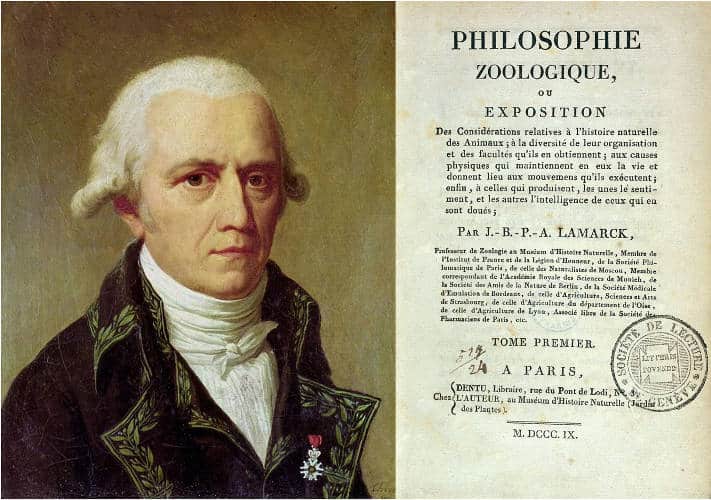
Above: Portrait of Jean-Baptiste Lamarck (by Charles Thévenin) and cover page of his Philosophie zoologique (1809).
Most people today would associate the theory of evolution with Charles Darwin, and with good reason: He was the first to point to natural selection as a fundamental mechanism. However, 50 years before Darwin, in 1809, it was a Frenchman who first put forward a scientific theory of biological evolution. The scientific community fully acknowledges this, and Darwin himself was the first to honor him for it.
His name was Jean-Baptiste Lamarck (1744-1829). Why then has he been overshadowed by Darwin? Despite being mentioned in every second-grade textbook the world over, it is mainly because of a discredited idea of ‘the inheritance of acquired characteristics.’ However, this was only a minor part of his theory, and Darwin shared it as well, which has been conveniently overlooked.
Lamarck put forward the ground-breaking thesis that changes in animals’ behavior were a decisive factor in evolution. Besides, he foreshadowed the emerging field of epigenetics – how behavior and environment cause changes that may be inherited beyond the genetic code. Today, he is finally returning to favor, also due to his many other scientific bequests to posterity.
However, Lamarck’s religious faith has been overlooked as well and continues to be. Until today, he has generally been perceived as a deist. However, my research has shown that he was strongly influenced by Thomas Aquinas as the philosophical basis for his theory of evolution. The founder of evolution was indeed a Catholic.
This article is based on an abridged version of the chapter about him in my book, The Wonder of Creation: The Most Famous Christian Biologists in History (Queenswood, 2025).
From soldier to scientist
Jean-Baptiste Lamarck was born on August 1, 1744, at Bazentin in Picardy, the region of Somme, in Northern France. He was the youngest of eleven children, born to a large and aristocratic but poor family. Because of the family’s unimportant societal standing, we do not know much about the private aspects of his life.1 But we do know that his father intended him for the Catholic priesthood; so Jean-Baptiste entered the Jesuit college at Amiens around the age of eleven. However, he himself wished to pursue and uphold the family’s long line of military honor. So, after the death of his father and when the Jesuits were expelled from France, he bought himself a horse and set off to fight the German enemy.
His military career was brilliant but cut short due to an injury. Forced to spend a long time in recovery, Lamarck indulged in a book on botany, and this became a turning point for him. When he was eventually dismissed from the army, with a measly military pension, he resolved to pursue a career in botany.
In Paris, he became a student under the notable French naturalist Bernhard de Jussieu and became acquainted with the royal botanical garden, the Jardin du Roi, which, at the time, was the center of natural history and biological research in France. Ten years of research followed, and in 1778, Lamarck had his observations and results published in a three-volume work called Flore françoise, which brought him great acclaim. Soon, Lamarck became known as the ‘French Linnaeus.’
His publication had been supported by the director of the Jardin du Roi, Comte de Buffon, a great naturalist and mathematician. Owing to his patronage, Lamarck was elected to the French Academy of Sciences. He also secured Lamarck’s position as an assistant botanist and ’keeper of the herbarium’ at the Jardin du Roi. However, none of the jobs he held paid much, and for most of his life, his income was poor.
During the difficult years of the French Revolution, he had to fight for his work and his title. He managed to reorganize the Jardin du Roi as the National Museum of Natural History and was subsequently appointed a professor – however, not within the field of botany, but in the natural history of insects and worms. The botanist went on to become a zoologist.
Being a ‘professor of insects and worms’ was definitely not a prestigious position. But Lamarck became curious about these animals, which were so numerous and so diverse in form in nature. He took on the enormous challenge of learning about, and indeed creating, a new field of biology – that of invertebrate zoology – and by doing so, he made substantial contributions to the classification of animals, which are still recognized today.
Lamarck’s theory of evolution
In his early years, Jean-Baptiste Lamarck did not question the immutability of species or the generally held belief in a special creation, which was the standard explanation in the Western world for the origin and existence of life on Earth until the late nineteenth century. Species might well change to some degree, but not from one species to another.
Lamarck’s theory of evolution, or transformation (‘transformism’), as he preferred to call it, was based on his massive reorganization of the Museum’s collections of invertebrates. Discovering, as he carried out his work, that the animals varied by sometimes minute degrees, Lamarck began to formulate new ideas about the relationship between animals, based on their supposed affinities. At the same time, he was familiar with palaeontology and had excavated fossil remains around Paris. Thereby, he gained a clear understanding of the climatic significance of fossils, as shown, for instance, by the discovery of animal fossils indicative of tropical environments. He openly challenged conventional wisdom in his Hydrogéologie of 1802: “Oh, how very ancient the Earth is! And how ridiculously small the ideas of those who consider the Earth’s age to be 6,000 years!” 2
So, before Lamarck put forward his theory of evolution, he was convinced of the significance of the two agents furthering species formation: time and environment. But there was also a third argument that seemed to be in favor of evolution. Recognizing that many of the fossilized animals no longer existed, there were only two explanations: either they had died out by means of some catastrophe – a view promoted by his colleague at the Museum, Georges Cuvier. Or, alternatively, those animals had not died out but instead been transformed into new species.
Lamarck’s full theory of evolution was expounded in his principal work, Philosophie zoologique, in 1809 – the year of Charles Darwin’s birth.3 In that book, Lamarck argues that a natural system of classification of animals should be based on their supposed affinities: “The aim of a general arrangement of animals is not only to possess a convenient list for consulting, but it is more particularly to have an order in that list which represents as nearly as possible the actual order followed by nature in the production of animals; an order conspicuously indicated by the affinities which she has set between them.” 4 Fifty years later, Darwin, in his Origin of Species (1859) would argue the same. But whereas Darwin had forerunners to pave the way, including Lamarck himself, and a more benign environment around him, Lamarck stood quite alone in defense of his theory of evolution.
He concluded: “Nature has produced all the species of animals in succession, beginning with the most imperfect or simplest, and ending her work with the most perfect, so as to create a gradually increasing complexity in their organization; these animals have spread at large throughout all the habitable regions of the globe, and every species has derived from its environment the habits that we find in it and the structural modifications which observation shows us.” 5
This passage is, in essence, what Lamarck’s theory was about. Obviously, it consists of two parts, a vertical and a horizontal dimension: The vertical dimension is a linear order of increasing complexity, showing the progression of organisms from simple to complex organization, reflected by his classes of the animal kingdom, starting with the infusorians and working up to mammals. The horizontal dimension, or the ‘lateral ramifications,’ as he named it, is the secondary transformation of species due to different kinds of environments and the resulting change of animal habit and behavior, causing structural modifications. For example, there is a major branching event where the reptiles diverge into the birds and the mammals.
Well before Darwin, who is normally credited for being the first to depict a ‘tree of life,’ Lamarck showed how an evolutionary model could be illustrated as a tree with its ‘branches’ indicating common descent and unity in nature.
Thus, Lamarck anticipated modern evolutionary theory. As it has been stated: “Within the maddening, confusing and repetitive pages of Lamarck’s exposition lurk concepts that are central to modern evolutionary thought. Stated in contemporary terminology, they include the ideas that species change through evolutionary time; that evolutionary change is slow and imperceptible; that evolution occurs through adaptation to the environment; that it generally progresses from simple to the complex, although in a few cases it proceeds in reverse; and that species are related to one another by common descent.” 6
Already Charles Darwin himself, in his Origin of Species, paid tribute to his French counterpart as the father of evolution: “Lamarck was the first man whose conclusions on this subject excited much attention. This justly celebrated naturalist first published his views in 1801, and he much enlarged them in 1809 in his Philosophie zoologique. … In these works, he upholds the doctrine that all species, including man, are descended from other species. He first did the eminent service of arousing attention to the probability of all changes in the organic, as well as in the inorganic world, being the result of law, and not of miraculous interposition.” 7
It is not difficult to find flaws in Lamarck’s theory, in particular, the idea of ‘the inheritance of acquired characteristics.’ Lamarck believed that the long necks of giraffes evolved as generations of giraffes reached for ever higher leaves. However, inheritance was not the central issue for him (this was also long before Gregor Mendel made his discoveries), and Darwin himself shared this dubious idea, too, as an alternative to natural selection. What was important to Lamarck was his idea that behavior plays a major role in the evolution of species, such as giraffes reaching out to catch the top leaves of trees.
The order in which things happened is important, as he stated: “It is not the organs … of an animal’s body that have given rise to its special habits and faculties; but it is, on the contrary, its habits, mode of life and environment that have in the course of time controlled the shape of its body, the number and state of its organs and, lastly, the faculties which it possesses.” 8
Thus, compared to Darwin’s theory, where inherited variations happen first, including structural changes in organs, Lamarck emphasized that behavior changes first. In Darwinian theory, the way that the habits, mode of life, and environment of an animal control its form over the course of time is more indirect. Variations in gene complexes that are helpful to the animal in its mode of life and make it better adapted to its environment are favored by natural selection and thereby affect the animal’s form in future generations. Thus, the way Darwin himself explained the giraffe’s form is that a competitive advantage was enjoyed by those proto-giraffes that could reach higher leaves, so that over time natural selection favored those variants with longer necks and legs. Even in the Darwinian account, however, it remains the case that animals, by their own behavior and habits, do have an effect on the selection pressures that act upon them and their descendants and, accordingly, influence the course that evolution takes. (Incidentally, with respect to giraffes, it should be noted that more recent research casts doubt on the idea that reaching higher leaves was the particular competitive advantage that led giraffes to develop longer necks.)
More generally, Lamarck has witnessed a remarkable ‘comeback’ in recent times within epigenetics – for the same reason that he had previously been criticized. Epigenetics is the study of changes in organisms caused by modification of gene expression rather than alteration of the genetic code itself. It turns out that the epigenome responds to a variety of factors in the environment, like diet and toxins, and while it does not change the DNA sequence of the genes, some of the epigenomic changes acquired during a lifetime are indeed passed on to progeny through the sperm and the egg. This has certainly given the idea of ‘inheritance of acquired characteristics’ quite a new meaning and significance.
In his Philosophie, he puts forward the hypothesis that humans and apes might have shared a common origin – long before Darwin made a similar statement in his Descent of Man (1871). His hypothesis is based on a comparison between the skeletons of apes and humans, related to their behavior and way of living. The ancestor might have abandoned tree-dwelling existence, which would have left the hands free for the use of tools and led to a progressive development of senses and abilities, which, in turn, led to new needs and a new way of communicating – language. This, in turn, led to civilization and industry until this ‘race’ displaced the other animals and became the lord of the planet.9 This is still the standard model of the evolution of human beings. It shows astonishing foresight, all the more so because no fossil intermediates between apes and humans were known in 1809.
Today, Lamarck is far more recognized than before and is not only treated as Darwin’s anti-hero. Lamarck was far ahead of his time, not only in terms of evolution and classification of living things. He anticipated the species concept and the cell theory, and he introduced the term ‘biology’ in science.
God creates, nature produces
It has been estimated that Lamarck had little empathy for traditional Christian beliefs – judged from having postponed marrying his first wife until her deathbed – and he is often regarded as simply a deist.10 But after all, we do not know his circumstances, and we have only very scarce and indirect information about his religious beliefs apart from what is indicated in his scientific writings. Here, and especially in his main work, the Philosophie zoologique, he clearly professes the views of a theist and a Catholic, and there is no reason to think that the former brave soldier did not stand by his public statements.
Lamarck several times refers to God as the Almighty Creator or ‘the Supreme Author of all things.’ It is important to note what he meant by this statement. If he were a deist, God would be like a watchmaker who created the universe in the distant past and set its mechanisms in motion. Nature would be like a large-scale watch, completely autonomous and self-sufficient, and no action by God would be needed. But this is not what Lamarck thought. What has hitherto remained unnoticed by his biographers is that Lamarck seems to have been deeply influenced by the Catholic philosopher Thomas Aquinas, whom he presumably had already learned about during his stay in a Jesuit college as a young man. Aquinas explained the Christian doctrine of creation in this way: to create is to cause existence, and all things are totally dependent upon the Creator for the very fact that they are. Nature, with all its objects, is at any time dependent on God, who keeps it in existence from moment to moment or “so long as it pleases its Sublime Author to continue its existence”, as Lamarck repeatedly argues in different ways.11
Accordingly, the world that human beings observe must have been brought into being by God as the first cause. Following Scripture (Genesis 1:1), the world has a beginning, created by the eternal God through his Word, and Lamarck believed as such: “The idea of nature as eternal, and hence as having existed for all time, is for me an abstract opinion without foundation, finality, or probability, and with which my reason could never be satisfied … I prefer to think that the whole of nature is only an effect: hence, I imagine and like to believe in a First Cause or, in short, a Supreme Power which brought nature into existence and made it such as it is.” 12
Lamarck’s theory was controversial, especially since God did not seem directly involved in creating the different forms of life. However, to understand his view of the relation between God and nature, he also shows his dependence on Aquinas. As told in the Bible (Genesis 1:11 and 1:22, for example), God is the sovereign master of creation, but to carry out his plan, he makes use of the cooperation of his creation. With this in mind, Aquinas distinguished between God’s creative act and the modality by which he acts. God causes creatures to exist (primary causation) in such a way that the creatures are real causes (secondary causation) of their own operations. God and his creatures work together simultaneously at fundamentally different levels: Each new creation comes totally and immediately from God as the primary cause and totally and immediately from another creature as the secondary cause. God acts indirectly, through secondary causes, so that all material objects, created by God with their own potentialities, can develop in accordance with the laws of nature. And, according to Lamarck, God uses evolution as a second or instrumental cause to produce new species. In his own words, ‘God creates and nature produces’: “To create, or to make anything out of nothing, this is an idea we cannot conceive of, for the reason that in all that we can know, we do not find any model which represents it. God alone, then, can create, while nature can only produce. We must suppose that, in his creations, the Divinity is not restricted to the use of any time, while, on the other hand, nature can effect nothing without the aid of long periods of time.” 13
In this way, he also tried to convince his readers that the six days of Genesis should be interpreted as long periods, in line with Aquinas’ position that the Bible is not a textbook in the sciences.
Similarly, God’s action is different from nature’s action, and he is not accessible to human observation or investigation, whereas nature is: “Doubtless, nothing exists but by the will of the Sublime Author of all things; but can we set rules for him in the execution of his will, or fix the routine for him to observe? Could not his infinite power create an order of things, which gave existence successively to all that we see as well as to all that exists but that we do not see? Assuredly, whatever his will may have been, the immensity of his power is always the same, and in whatever manner that supreme will may have asserted itself, nothing can diminish its grandeur. I shall then respect the decrees of that infinite wisdom and confine myself to the sphere of a pure observer of nature. If I succeed in unraveling anything in her methods, I shall say without fear of error that it has pleased the Author of nature to endow her with that faculty and power.” 14
Thus, God shares some of his power with nature, and also, the transformation of species is made possible by his creative activity. Nature is evidence of God because his power acts through nature. In a sense, therefore, the power of nature is limited, with no intention, goal, or will: “It is a power that, great as it may be … can only exist as a result of the will of a higher and boundless power which, being the one who established it, is the real author of all that comes from it, of all that, in the end, exists.” 15 Again, we are far from just an autonomous deist view of nature.
This is also evident when it comes to the question of teleology. This term (meaning ‘directed toward a goal’) was used by Aquinas to indicate that things do not only exist but that they also appear to have been designed with some purpose in mind. Lamarckian evolution steers toward a goal: complexity, the perfection of species, and ultimately the perfect human race: “This is particularly true since man is the latest result and present climax of this development, the ultimate limit of which, if it is ever reached, cannot be known.” And elsewhere he writes: “with a purpose that is known to its Author alone.” 16 As Lamarck indicates, a distinction should be made between natural finality or directedness, such as observable complexity or adaptation, and an ultimate, Divine plan, which is unknown to humans, corresponding to the two levels of causality.
Humans, in Lamarck’s view, are privileged beings with extreme superiority over other living creatures, distinguished from all of them by their reason. He states that since the ‘immortal soul’ of humans and the ‘perishable soul’ of animals cannot be known physically, they are not a proper concern for science. In his last book, he states that humans are also the only creatures who can recognize the existence of God: “He is also the only one who has perceived the necessity of recognizing a superior and only cause, Creator of the order of the wonders of life. By this, he is led to raise his thoughts to the Supreme Author of all that exists.” 17
Personality and end of life
All evidence points to Jean-Baptiste Lamarck as a noble character. His first biographer states about him (1901): “We know that in character he was pure and sweet, self-sacrificing, self-denying, and free from self-assertion,”18 a description which cannot be given to all pioneering scientists in history, neither before nor after him.
Indeed, Lamarck met difficulties and suffering throughout his life. During his lifetime, he was mostly recognized for his works on plants and invertebrates. His far-reaching ideas about evolution were strongly opposed or fell on deaf ears among the establishment of the day.
As for his finances, Lamarck never came to afford a wealthy lifestyle, and he had difficulties supporting his family. His life was saddened and embittered by the loss of his wives and the loss of three of his children. For around ten years, his daughter, Cornelie, took care of her father, who eventually became totally blind. On December 28, 1829, Lamarck died at the age of 85, blind and poor, surrounded by unsold copies of his books.
At last, in 1909, on the anniversary of his Philosophie zoologique, Lamarck received his first official recognition as a great scientist. A large bronze statue of him was inaugurated in the Jardin des Plantes in the presence of the French president.
It has the inscription: ‘Fondateur de la doctrine de l’evolution.’
[Niels Arboel has an M.Sc. in Biology and B.A. in Christian Studies from the University of Copenhagen, and is the author of The Wonder of Creation: The Most Famous Christian Biologists in History (Queenswood, 2025).]
References
1. A. Packard, Lamarck, the Founder of Evolution. His Life and Work (Longmans. Green and Co., London, 1901), p. 11-12. All biographical details in this article are based on this work.
2. J.-B. Lamarck, Hydrogéologie (Agasse et Maillard, Paris, 1802), p. 88.
3. J.-B. Lamarck, Philosophie zoologique (Dentu, Paris, 1809). The quotations in this article from J.B. Lamarck, Zoological Philosophy, translated by Hugh Elliot (Hafner Publishing Company, New York, 1963) (first published 1914).
4. ibid., p. 56.
5. ibid., p. 126.
6. D. Grauer, et al., “In Retrospect: Lamarck’s Treatise at 200”, Nature 460, 2009, p. 688.
7. C. Darwin, Origin of Species, 3rd ed. (John Murray, London, 1861), p. xiii.
8. See Ref. 3, p. 114
9. ibid., p. 170-173.
10. M. Ruse, Monad to Man: The Concept of Progress in Evolutionary Biology (Harvard University Press, 1996), p. 11.
11. See Ref. 3, p. 180.
12. ibid., p. 183-184.
13. J.-B. Lamarck, Système analytique des connaissances positives de l’homme, Principes primordieux (Germer Ballière, Paris, 1820), p. 12. Translation by the author.
14. See Ref. 3, p. 36.
15. J.-B. Lamarck, Histoire naturelle des animaux sans vertèbres, I (Paris, 1815) p. 311. Translation by the author.
16. J.-B. Lamarck, Hydrogeology (translation by A.V. Carozzi (University of Illinois Press, Urbana, 1964) p. 77. See also Ref. 3, p. 180.
17. See Ref. 13, p. 7-8. See also J.-B. Lamarck, Recherches sur l’organisation des corps vivants (Maillard, Paris, 1802), p. 124.
18. See Ref. 1, p. 373.